
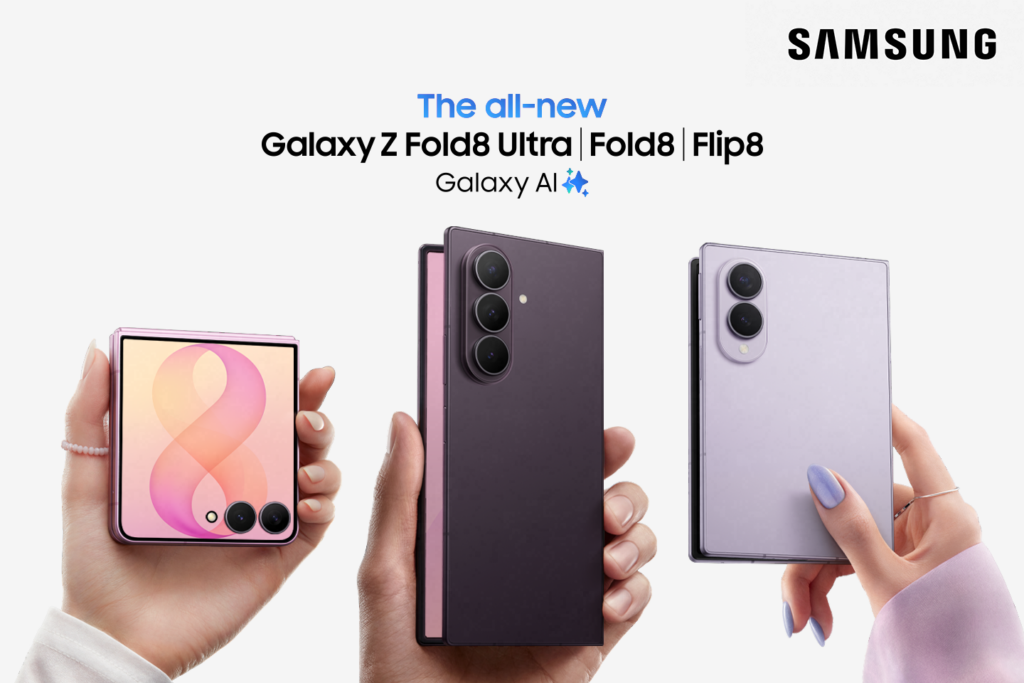
Since Samsung first shook up the mobile industry back in 2019, foldable phones have evolved from experimental tech into a mature category. But according to Nathan Rigger, Head of Product for Mobile at Samsung Australia, the upcoming 8th generation represents the biggest leap forward yet.
Speaking in a recent interview with Tech Daily, Rigger pulled back the curtain on how Samsung is completely rethinking hardware, durability, and display engineering across its new foldable ecosystem that includes the Galaxy Z Fold8 Ultra, Galaxy Z Fold8 and Galaxy Z Flip8.
The Foldable Disappearing Crease
For years, the visible crease has been the primary compromise of owning a foldable device. Samsung’s solution for the eighth generation is as ambitious as it is structural.
“What we’ve done is streamline the display by putting two titanium layers into effectively our display stack that allows us to achieve a few things. Firstly, a much thinner device. Second one is a more immersive display, so it effectively removes the crease from the device. And the third one is that it makes the device and the display even stronger and more durable than before.”
By sandwiching dual titanium layers directly into the display stack, users aren’t just getting a more visually seamless screen when unfolding their favorite content—they are getting a significantly tougher daily driver.
Conquering Outdoor Glare
Another major pain point for foldable users has been outdoor visibility. Samsung has addressed this by combining an advanced anti-reflective coating with a massive boost in panel brightness.
“So this anti-reflective coating will effectively reduce glare. We’ve also made another change in which improves the brightness of the display itself up to 3,000 nits. So not only are you going to get anti-reflective benefits, but a brighter display as well.”
Whether you’re caught in direct sunlight or working in an brightly lit office, the combination of lower glare and 3,000 nits of peak brightness ensures the screen punches through ambient light with ease.
Australians Want Foldable Devices
Foldables are no longer a niche conversation. Rigger noted that consumer adoption has skyrocketed locally and globally, propelled by the massive success of previous iterations like the Galaxy Z Fold 7.
“Well, we’re really excited. So as one of the pioneers of the foldable category, both here in Australia and globally, we’ve seen a lot of traction and success, especially last year with our Galaxy Z Fold 7. It set all new sales records for us in Australia and globally, for that matter. And we’ve seen our install base of foldable users grow. So it’s grown three times the size since 2021. So there are more foldable users in Australia than ever before, and we’re starting to still continue to see a lot of appetite and interest into this segment of the market.”
The Ultra Factor: Best of Both Worlds
For power users looking for zero compromises, the introduction of the Fold Ultra tier bridges the gap between Samsung’s traditional slab flagships and its flexible ecosystem.
“From a flagship standpoint, you’re getting the best of both worlds: the foldable form factor, everything that you love about Ultra… It comes with our best camera, our best display, our best performance.”
By bringing top-tier S-Series hardware—including elite camera sensors, uncompromised chipsets, and massive battery capacities—into a foldable chassis, Samsung is making sure power users don’t have to sacrifice performance for innovation.
With a lighter footprint, improved form factors like the new wallet-style standard Fold 8, and cutting-edge silicon-carbon battery cells, Samsung’s eighth generation proves that the company isn’t just resting on its pioneering laurels. They’re setting an entirely new standard for what pocket technology can do.
You can discover more about the new Galaxy Z Fold8 Ultra, Galaxy Z Fold8 and Galaxy Z Flip8 at samsung.com/au/smartphones/galaxy-z/